
1. Understand what you are trading
Forex is the exchange of one currency for another. Currency pairs such as EUR/USD show the value of one currency relative to another. With some products, you exchange or hold the currencies themselves. With leveraged forex or a contract for difference (CFD), you may instead speculate on price movements without owning the underlying currency.
Check the product description and account agreement carefully. The platform’s name or the word “forex” in an advertisement does not, by itself, tell you how the trade is structured. The product type affects how prices, costs, leverage, and risk work.
2. Learn the basic terms before risking money
Before trading, make sure you can explain these terms in your own words:
- Currency pair: The two currencies being compared, such as EUR/USD.
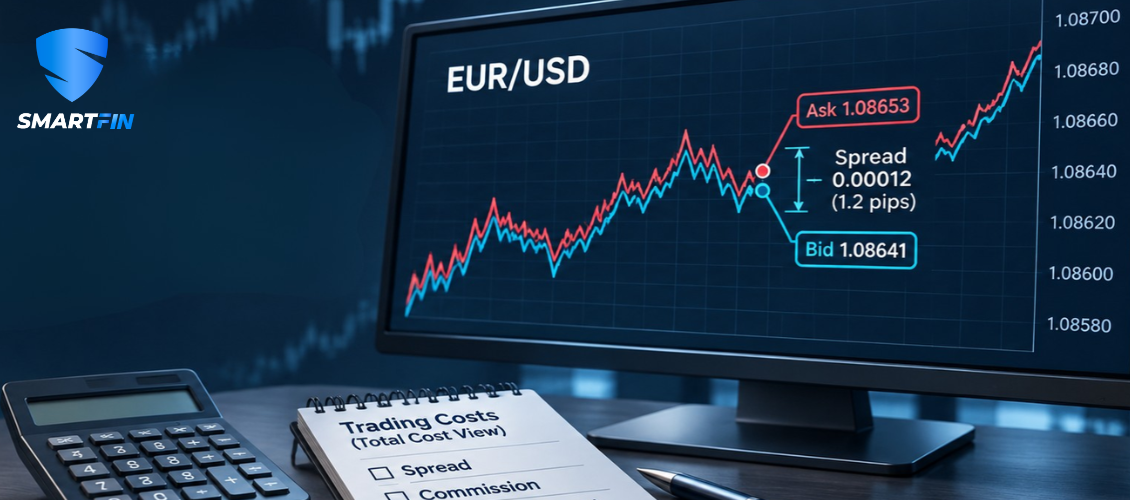
- Bid and ask: The prices at which you can sell or buy, respectively.
- Spread: The difference between the bid and ask price.
- Pip: A standard way to measure price movement for many currency pairs. Read our guide to what a pip means in forex.
- Lot size: The size of a position.
- Margin and leverage: The funds required to open a leveraged position and the larger market exposure that leverage can create.
- Stop-loss order: An instruction intended to close a trade at a specified level. In fast or gapping markets, the final execution price may differ from the requested level.
Understanding these terms helps you read the platform and estimate a trade’s possible impact before placing an order.
3. Verify the provider and the specific legal entity
A broker’s brand name, office address or trading app does not confirm which legal entity will provide your account. Before sending money or identity documents, find the entity’s full legal name in the account agreement and verify it independently.
UAE financial services operate across different regulatory jurisdictions. Depending on where the firm operates and the service it offers, relevant registers may include the UAE Capital Market Authority’s licensed companies register, the DFSA Public Register for firms regulated in the Dubai International Financial Centre, or the FSRA Public Register for firms regulated in Abu Dhabi Global Market. These registers allow users to check firms and, where available, their activities or permissions.
Match the legal entity, website domain, contact details and permissions shown in the register with the information in the agreement. A company being registered in a jurisdiction is not the same as having permission to provide every financial service. ADGM’s investor guidance also advises checking that the firm is authorized for the service being offered and using the official register rather than links sent by the firm.
4. Compare the full trading terms
Do not compare providers using only the advertised spread or minimum deposit. Read the account terms and check:
- Spreads and whether they can widen in changing market conditions
- Any commissions or other transaction charges
- Overnight financing or swap charges
- Minimum and maximum trade sizes
- Margin requirements and what may happen if margin falls
- Deposit and withdrawal methods, processing terms and any applicable fees
- Which entity holds the account and handles execution or client support
Ask for clarification if a cost, execution arrangement or withdrawal condition is unclear. SmartFIN’s guide to forex account costs, MT5 and trading risks can help you understand the questions to ask.
5. Practice on a demo account
A demo account lets you explore order types and platform features using simulated funds. Use it to practice placing and closing trades, setting stop-loss and take-profit orders, checking position size, and reviewing how unrealized profit or loss changes as prices move.
Treat demo trading as platform practice, not proof that a strategy will perform the same way with real money. Demo conditions may not fully reflect live execution, market liquidity or the emotional pressure of trading actual funds. Before moving to a live account, you should be comfortable explaining why you would enter a trade, where you would exit and how much you could lose.
6. Make a risk plan and calculate position size
Decide on your maximum acceptable loss before placing a trade. Position size should be based on that amount and the distance to your planned exit—not simply on the largest trade size the platform allows.
For example, suppose a hypothetical position has a pip value of $1 per pip, and the planned stop is 30 pips away. The estimated loss at that distance would be $30, before costs and any difference between the requested and final execution price. A different position size or currency pair would change the pip value and the estimate.
This example shows why a pip count alone does not tell you the monetary risk. Learn how margin and leverage affect a forex trade, and remember that a stop-loss order cannot guarantee an exact exit price in every market condition.
7. Open an account only after reviewing the documents
If you decide to proceed, read the application and account agreement before accepting them. Providers commonly request identity and address information as part of their verification process; the exact documents and steps depend on the provider and account type. Make sure you understand who you are contracting with, where to send funds, how withdrawals work, and where to raise a complaint.
For a more detailed checklist, see the guide to opening a forex trading account in Dubai. Review the provider’s current terms directly before applying, since account conditions can change.
8. Keep records and review your decisions
Maintain a trading journal with the instrument, reason for entry, position size, planned exit, result, and any costs. Reviewing these records can help you identify whether you are following your plan or making impulsive decisions. It can also show whether you understand the product’s costs and how your chosen trade size affects results.
Avoid borrowing money to trade or using funds needed for rent, bills, emergencies, or other essential expenses. Be cautious of anyone promising guaranteed returns, pressuring you to deposit quickly, or asking you to transfer funds to a personal account.
Frequently asked questions
Can I start forex trading in the UAE as a beginner?
You can start by learning how different forex products work, checking the provider and its permissions, and practicing with a demo account. Consider the risks and costs before using real money.
How much money do I need to start?
There is no single amount suitable for everyone. Minimum deposits vary between providers, but a low minimum does not mean a trade is low risk. Understand the position size and potential loss before depositing.
Is MetaTrader 5 a broker?
No. MetaTrader 5 is trading software. Check which legal entity provides the account and the relevant financial service, and verify its permissions independently.
Is forex trading risk-free if I use a stop-loss?
No. A stop-loss can be part of a risk plan, but market gaps or fast price movements can cause execution at a different price. Leverage can magnify losses.
How should I choose a currency pair?
Start by learning how a pair is quoted, what may move its price, and what the provider charges to trade it. Practice first and avoid choosing a product solely because it is popular or highly volatile.
Risk warning: Forex and CFD trading involves risk and may result in the loss of your capital. Leverage can magnify both gains and losses. This article is for educational purposes only and is not investment or legal advice.