What does “pip” mean in forex?
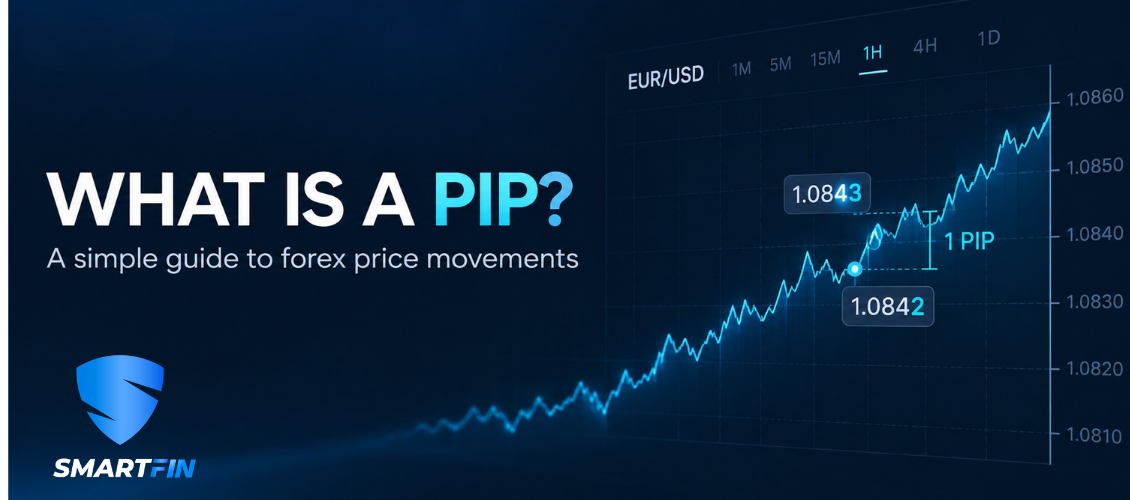
Forex prices are quoted as currency pairs, such as EUR/USD or USD/JPY. A pip gives traders a common way to describe a change in the exchange rate. Instead of saying that EUR/USD moved by 0.0035, a trader might say it moved by 35 pips.
The conventional pip size depends on the pair:
- Most non-JPY pairs: one pip is a change of 0.0001.
- Most JPY pairs: one pip is a change of 0.01.
These conventions make it easier to discuss price changes, compare movements, and measure a trade’s result. Your trading platform may show extra decimal places, so it helps to check which digit represents a full pip.
How to count pips on a currency pair
Consider EUR/USD moving from 1.0842 to 1.0877. The difference is 0.0035. Since one pip for this pair is 0.0001:
0.0035 ÷ 0.0001 = 35 pips
EUR/USD has risen by 35 pips.
For USD/JPY, imagine the price changes from 150.20 to 150.65. The difference is 0.45. Since one pip is 0.01:
0.45 ÷ 0.01 = 45 pips
USD/JPY has risen by 45 pips.
The same method works when the price falls. If EUR/USD moves from 1.0842 to 1.0812, it has fallen by 30 pips. Whether that move creates a gain or loss for a particular position depends on whether the trader bought or sold the pair, as well as the trade size and costs.
What is a pipette?
Some platforms show one more decimal place than the standard pip position. That extra digit is commonly called a pipette or fractional pip. It represents one-tenth of a pip.
For example, a five-decimal EUR/USD quote might move from 1.08420 to 1.08430. The final digit changes by one, but the price has moved 0.00010, which is one full pip. A move from 1.08420 to 1.08421 is one pipette, or one-tenth of a pip.
On a three-decimal USD/JPY quote, a move from 150.200 to 150.210 is one full pip. The additional third decimal place shows fractional pip movement.
What is pip value?
A pip measures a price change. Pip value tells you how much that change is worth in money for a particular trade.
For a standard lot of 100,000 units of EUR/USD, one pip is typically worth $10 when the account currency is USD. For a mini lot of 10,000 units, it is typically $1 per pip; for a micro lot of 1,000 units, it is typically $0.10 per pip. These examples apply to EUR/USD with USD as the quote currency and account currency. Pip value can differ for other pairs and account currencies.
A simplified calculation for a pair where USD is the quote currency is:
Pip value = trade units × pip size
For a 10,000-unit EUR/USD position:
10,000 × 0.0001 = $1 per pip
If the position moves 20 pips in the trader’s favour, the movement is worth $20 before spreads, commissions, financing charges, or other applicable costs. A 20-pip move against the position would have the same approximate value in the opposite direction.
For pairs where the quote currency is not the account currency, the pip value must be converted. Exchange rates also affect the calculation. That is why a pip does not have one fixed monetary value for every forex trade.
Why does pip value change with trade size?
A price move of 10 pips is the same distance regardless of position size, but its monetary effect grows as the position gets larger. If a pip is worth $0.10 on one position and $1 on another, a 10-pip move corresponds to $1 and $10 respectively, before trading costs.
This is why traders should understand both the pip distance and the position size before placing an order. A stop-loss set 30 pips away does not, by itself, tell you the potential monetary loss. You also need to know the pip value for the selected trade size and account currency.
How pips relate to spreads and trading costs
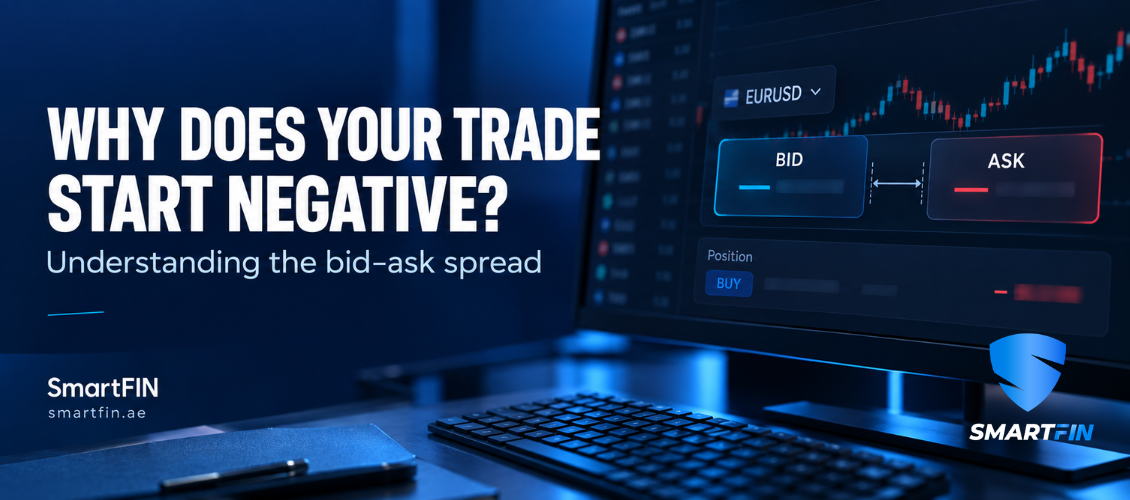
The spread is the difference between a currency pair’s bid and ask prices. It is often expressed in pips. If a pair has a 1.2-pip spread, the spread is 1.2 times the monetary value of one pip for the position size being traded.
The spread is only one possible trading cost. Depending on the instrument and account terms, a trade may also involve commission, overnight financing, or other charges. These costs can affect the overall result even when the market price moves in the expected direction.
Do pips work the same way for gold, indices and other CFDs?
The pip convention described above applies to currency pairs. Gold, indices, shares and other contracts for difference (CFDs) may use different price increments, contract specifications or platform labels. Some platforms may display a “point” or “tick” instead of a pip for these products.
Before calculating a potential gain or loss, check the instrument’s contract specifications: the minimum price movement, contract size, tick value, and how the instrument is quoted. Do not assume that a pip on EUR/USD has the same meaning or cash value as a point on gold or an index.
Common mistakes when reading pips
Confusing a pip with a pipette: On a five-decimal quote, the final decimal is usually a fractional pip. One pip on EUR/USD is still 0.0001.
Assuming every pip has the same cash value: Pip value depends on the pair, trade size, exchange rate, and account currency.
Ignoring position size: A pip count alone does not show how much money a trade gained or lost.
Treating pips as a measure of risk: A 20-pip move may have a small or large monetary impact depending on the position. Risk also depends on leverage, available account funds, market conditions, and the exit plan.
Frequently asked questions
Is one pip always 0.0001?
No. For most currency pairs, one pip is 0.0001. For most Japanese yen pairs, one pip is 0.01. Other instruments may use different price increments, so check the platform and contract specifications.
How many pips are in 1.0000?
There are 10,000 pips in a price difference of 1.0000 for a pair with a 0.0001 pip size. For a pair with a 0.01 pip size, a difference of 1.00 equals 100 pips.
How do I calculate pips quickly?
Subtract the entry price from the exit price, then divide the difference by the pair’s pip size. Use the absolute result to find the number of pips, then check the direction of the move and whether the position was long or short.
Does a pip tell me how much profit I made?
No. A pip count tells you the size of the price movement. To estimate the monetary result, you also need the position size, the pair’s pip value, the account currency, and applicable trading costs.
Before placing a forex trade
Knowing "what is a pip" can help you read price charts, compare spreads, and understand how far a market has moved. It does not show the full financial impact of a position by itself. Check the pip value for the trade size and account currency, review the instrument’s specifications, and account for costs and possible losses before placing an order.
Risk warning: Forex and CFD trading involves risk and may result in losses. Leverage can magnify both gains and losses. This article is for educational purposes and is not investment advice.