This playbook gives you six checks to complete before you trade. It’s designed to help you assess the account and the process—not to tell you which currency pair to buy or sell.
What you’ll check
Present these as three cards:
- Know the provider
- Identify the legal entity named in your account agreement and verify its stated permissions.
- Know the cost
- Look beyond the spread. Check commissions, financing, currency conversion and execution.
- Know the risk
- Decide in advance what would invalidate your idea, what you can afford to lose and how you’ll review the result.
The six checks
1. Identify who provides your account
A brand name, website and trading platform may not identify the legal entity responsible for your account. Read the client agreement and note:
- The full legal name of the account provider
- Its jurisdiction and regulator
- Which company handles orders and client money
- Which entity handles withdrawals and complaints
If a company introduces you to another provider or helps with onboarding, check what each company does. Verify the legal entity in the relevant regulator’s register and read the permitted activities. A licence or registration should not be taken as permission to provide every financial service. The UAE regulator’s licensed-company information, for example, distinguishes between introduction permissions and trading or order-execution activities.
SmartFin link: How to identify the company behind a trading account
2. Read the instrument specification
Before opening a position, know what the instrument represents and how the provider defines it. Check:
- Contract size and minimum trade size
- Pip, point or tick size
- Value of a price movement in your account currency
- Trading hours and any daily break
- Margin requirements and stop-out rules
- Overnight financing for positions held past rollover
The same symbol name can have different contract specifications across providers. Use the specification for the account you would actually use, not a generic value found elsewhere.
3. Estimate the full cost
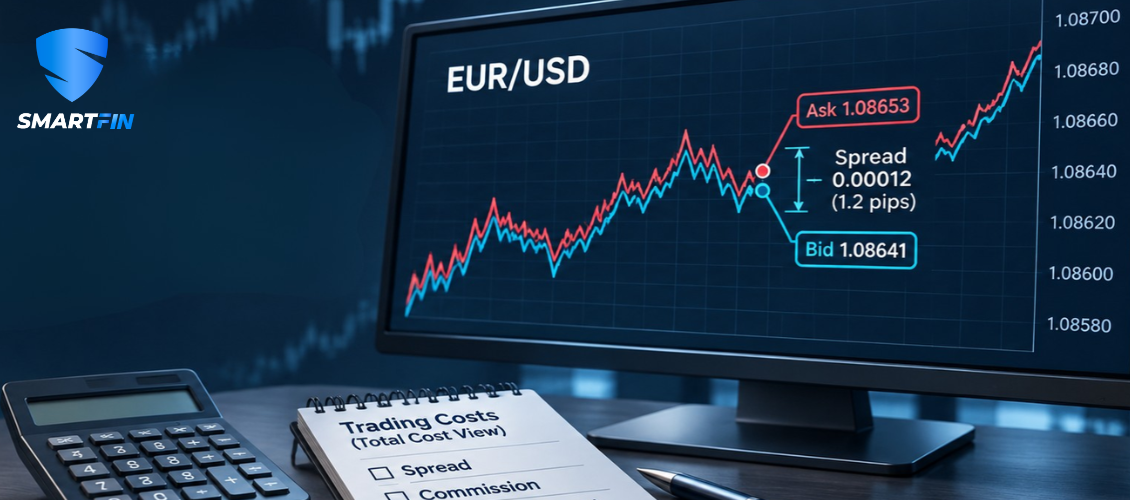
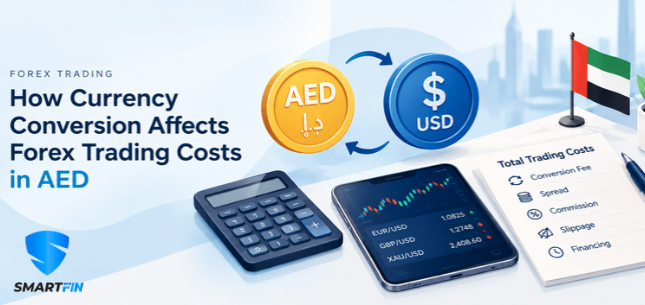
A spread is only one possible cost. Your account may also involve commission, overnight financing, conversion costs, slippage or payment-provider fees.
Use this simplified comparison:
Estimated trade cost = spread cost + commission + financing + applicable conversion or payment charges
For example, if a hypothetical EUR/USD position has a 1.2-pip spread and an approximate pip value of US$1, its spread cost would be about US$1.20. That estimate excludes commission, financing and slippage. The actual pip value depends on the contract size, position, price and account currency.
Use the provider’s current schedule and compare the same instrument, position size and holding period. SmartFin’s guide explains why low advertised spreads alone don’t establish the total cost.
SmartFin link: The real cost of forex trading
4. Define the risk before choosing the position size
Decide what price movement would show that your idea is no longer valid. Then estimate the loss if the position reaches that level.
A simple planning relationship is:
Estimated price-movement risk = position size × distance to exit level × value per price movement
This estimate is not a guaranteed maximum loss. Gaps, fast markets, slippage, financing and other charges may change the result. Position sizing should use the contract specification and the account’s own rules.
Illustrative example: If a hypothetical trader sets a maximum planned loss of AED 100 and the estimated loss per unit of position size at the selected exit level is AED 20, the calculation would allow five units. This example is for explaining the arithmetic only; it is not a recommended risk amount or trade size.
SmartFin link: Forex margin and leverage explained for UAE traders
5. Check the timing and the event risk
The UAE uses UTC+4, but session times shown on a UAE clock can shift when other financial centres change their clocks. A trading provider may also set its own instrument hours and platform server time. Confirm both before relying on a session schedule. www.gcaa.gov.ae
Before a trade, check:
- Whether the instrument is open
- Whether a daily break or rollover is approaching
- Whether scheduled announcements may affect the instrument
- Whether you can monitor the position during the period you choose
- Whether the provider’s spread or margin terms can change in volatile conditions
A more active session does not guarantee a better trade. It can also bring faster price changes and greater uncertainty.
SmartFin link: Forex market hours for UAE traders
6. Review the execution after the trade
Once the position is closed, compare what happened with your plan. Record:
- Entry and exit prices
- Spread and commission shown on the account
- Any slippage or rejected order
- Financing or other account adjustments
- Whether you followed your planned exit
- What you would change in your process next time
Use account statements and order history for the review. One trade cannot establish that a strategy works or that a provider’s execution is consistently good. Look for patterns across a suitable set of trades, and separate process mistakes from normal market uncertainty.
SmartFin link: Forex spreads, leverage and execution in the UAE
Your pre-trade card
Use this as a downloadable or on-page checklist:
- I know the legal entity providing my account.
- I checked the entity’s regulator and permitted activities.
- I read the instrument specification and account terms.
- I estimated spread, commission and other applicable costs.
- I estimated the loss if my planned exit is reached.
- I checked trading hours, rollover and relevant announcements.
- I know how I’ll review the order afterward.
Contact SmartFin
How SmartFin fits into the process
SmartFin’s educational pages describe Smart Securities Financial Services LLC as providing introduction services and state that the introduced provider is responsible for the trading account and execution. If you are considering SmartFin, read the current account documents to confirm which entity would provide your account and handle your funds and orders.
Related page: Who provides your SmartFin trading account?
Frequently asked questions
-Is this playbook a forex strategy?
No. It does not provide entry signals or tell you which instrument to trade. It is a set of checks for reviewing an account, trade costs, risk and execution.
-Does a low spread mean an account is low cost?
Not necessarily. Commission, financing, currency conversion, slippage and payment charges may also apply. Compare the complete terms for the instrument and account.
-Does MT5 identify my broker?
No. MT5 is trading software. Check your account agreement to identify the legal entity providing the account.
-Can a stop-loss guarantee the exact exit price?
Not in every market condition. Gaps and fast price changes can affect execution. Review the provider’s order-handling terms and risk disclosure.
-Does SmartFin execute trades?
SmartFin’s newer educational pages describe Smart Securities Financial Services LLC’s role as introduction services. Confirm the account provider and responsibilities in the current documents that apply to your account.
Risk disclosure
Forex and CFDs are complex, leveraged products and carry a high risk of loss. This article is for general information and is not investment advice or a recommendation to trade. Review the applicable account agreement and risk disclosure, and consider whether you understand the products and can afford the risk.