The forex market connects participants across financial centres worldwide. It generally operates around the clock during the trading week, but activity changes throughout the day. A currency pair may behave differently during a quiet session than it does when major markets are open or important economic data is released.
Consider EUR/USD. If its price rises, the euro has strengthened relative to the US dollar. If it falls, the euro has weakened relative to the dollar. That sounds straightforward, but a price movement alone does not tell you whether a trade is worthwhile. Your entry price, position size, trading costs and exit plan all affect the result.
What moves forex prices?
Interest-rate decisions, inflation reports, employment figures and economic expectations can change how traders value a currency. Political events and shifts in market confidence can also matter. The effect is not always predictable: a currency may move in the opposite direction to what a headline initially suggests if the news was already expected.
This is why forex trading involves more than choosing whether a chart will go up or down. A useful trading plan identifies the reason for a position, the price that would show the idea was wrong, and the amount of money at risk. Some traders use charts to study price behaviour; others follow economic events. Both approaches require a way to manage losses when the market does something unexpected.
Costs and risks to understand first
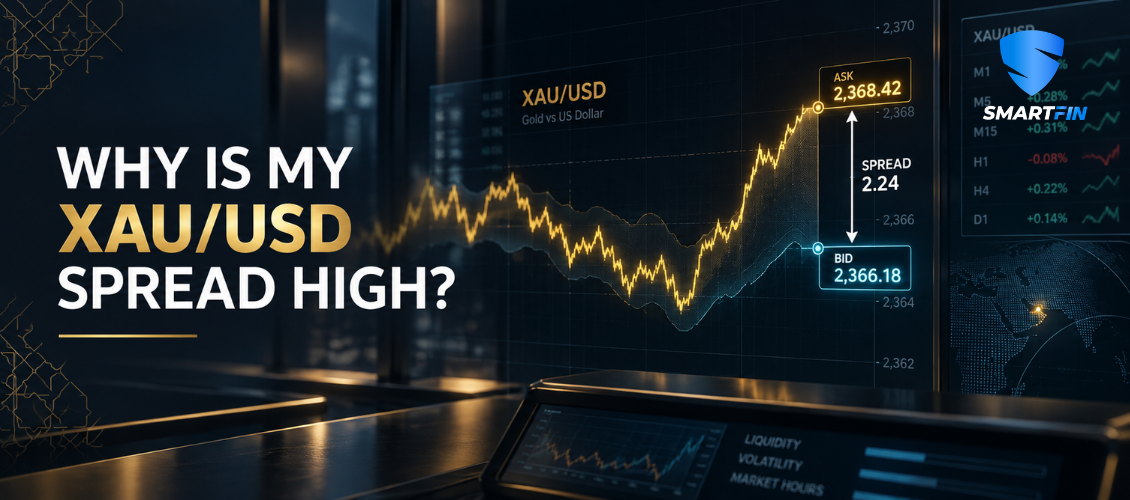
The spread is the difference between the price at which you can buy and the price at which you can sell. Depending on the account and product, you may also pay a commission or an overnight financing charge. Spreads and execution prices can change with market conditions, particularly around major news or periods of lower liquidity. Read more about the full cost of a forex trade.
Many forex accounts offer leverage, which allows a relatively small deposit to control a larger market position. Leverage magnifies losses as well as gains. A stop-loss order can help define an intended exit, but it does not guarantee a fill at the exact selected price in every market condition.
If you are new to forex trading, start by learning how position size, margin and order types work. Practising on a demo account can help you become familiar with a platform, although demo results may differ from live trading. SmartFin’s MT5 guide explains these platform basics in more detail.
Exploring forex trading with SmartFin
SmartFin helps people explore access to forex and other markets through its Dubai-based team. Before applying for an account, confirm which legal entity will provide the trading service, which products are available to you, and the terms that govern pricing, execution and withdrawals. Availability depends on your location and eligibility.
If you are considering an account, take time to review the application process and ask questions before depositing funds. The aim is to understand the service and its risks well enough to make your own decision.
Forex trading offers access to a global market, but access is only the beginning. Learning how currencies move, calculating the full cost of a position and setting a limit on potential loss are practical first steps. No platform or strategy can guarantee a profitable trade.
Risk warning: Forex and CFDs are leveraged products and carry a high risk of loss. This page is for general information and is not investment advice.