
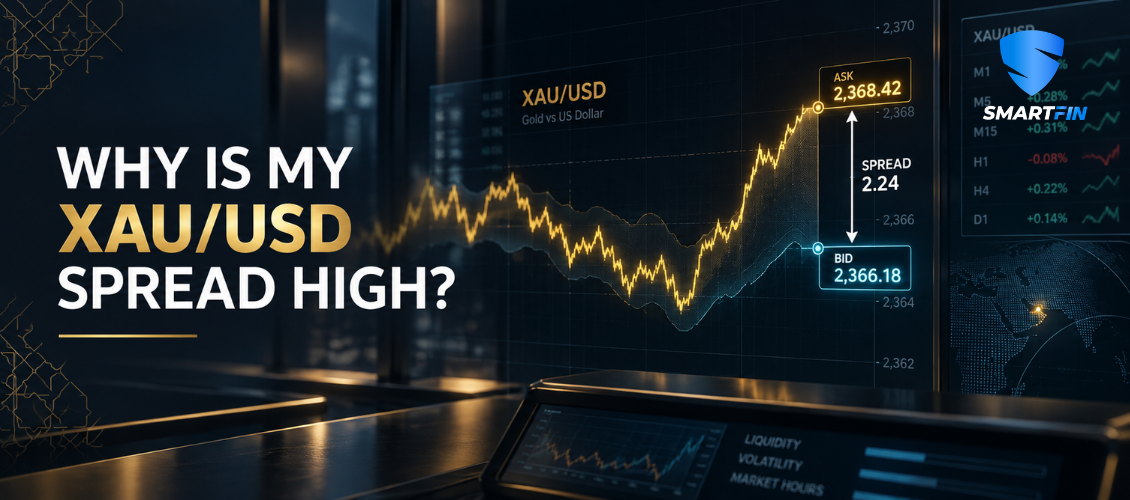
Gold is one of the world’s most actively followed markets, yet its trading conditions are not constant throughout the day. A trader may see a relatively narrow XAU/USD spread during an active session and a significantly wider spread several hours later—even when the market price has not moved very far.
Understanding why this happens can help UAE traders avoid unexpected entry costs, premature stop-loss activation, and position-sizing errors.
What Is the XAU/USD Spread?
The XAU/USD spread is the difference between the price at which a trader can buy gold and the price at which the trader can sell it.
For example, if XAU/USD shows:
- Bid price: $2,600.20
- Ask price: $2,600.50
The spread is $0.30.
A buy position normally opens at the ask price, while a sell position opens at the bid price. This means a new position begins with a small unrealized loss equal to the spread and any separate commission.
If the spread widens from $0.30 to $1.50, the market must move further in the trader’s favour before the position reaches break-even. The wider spread can also affect the activation of pending orders and stop-loss instructions.
The exact financial impact depends on the position size and the provider’s XAU/USD contract specifications. Traders should not assume that the same lot size, tick value, or spread calculation applies across every provider.
1. Lower Liquidity Can Widen the Gold Spread
Liquidity describes how easily a market can absorb buying and selling activity without a large change in price. When many participants are quoting and trading XAU/USD, the gap between available buying and selling prices is often narrower.
When fewer participants are active, there may be less competition between prices. The distance between the best available bid and ask can therefore increase.
Lower liquidity may occur:
- Between major trading sessions
- During the daily rollover period
- Around market holidays
- Near the weekly market close
- Immediately after the market reopens
- When a major financial centre is closed
- During unexpected disruptions
This does not mean that every low-liquidity period will produce an extreme spread. However, the possibility of wider pricing and less predictable execution usually increases.
A trader who opens positions only after checking the chart may miss this change. Before placing an order, examine both the bid and ask prices and review the current spread shown in the platform.
2. Volatility Makes XAU/USD More Difficult to Price
Gold can move rapidly when markets react to inflation, interest-rate expectations, bond yields, the US dollar, geopolitical risks or changes in demand for defensive assets.
During a fast market, quoted prices may become outdated almost immediately. Liquidity providers may respond by widening the distance between their bid and ask prices to reflect the increased risk of sudden movement.
High volatility can therefore produce two conditions at the same time:
- XAU/USD prices move more quickly.
- The spread becomes wider.
This combination can be particularly difficult for short-term traders. A wider spread raises the entry cost, while rapid price movement increases the possibility of slippage.
Traders should also remember that volatility is not measured only by the size of a completed candle. Conditions can change within seconds, even before a one-minute candle appears unusual.
When volatility is elevated, reduce dependence on extremely tight stops and avoid calculating position size using the normal spread alone. The current spread and possible execution difference should be included in the risk assessment.
3. Economic News Can Cause Sudden Spread Expansion
Major economic releases can cause gold prices to move sharply because they affect expectations for interest rates, inflation, economic growth and the US dollar.
XAU/USD spreads may widen before, during or immediately after announcements such as:
- US Consumer Price Index data
- Nonfarm Payrolls
- Federal Reserve interest-rate decisions
- Federal Reserve press conferences
- US retail sales
- Producer Price Index data
- GDP releases
- Employment and wage figures
- Unexpected central-bank announcements
Liquidity can temporarily decrease immediately before a major release because some market participants withdraw or reduce their quotations. Once the data is published, new orders may enter the market quickly, causing prices to jump between available levels.
A stop-loss is not guaranteed to execute at its requested price during these conditions. It becomes a market instruction when triggered and may be filled at the next available price. This difference is known as slippage.
Traders planning to hold a position through an important announcement should understand three separate risks: wider spreads, rapid price changes and execution away from the requested level.
An economic calendar should therefore be checked before every trading session, even when the trader does not use fundamental analysis to choose market direction.
4. The Daily Rollover Period Can Produce Wider Spreads
One of the most common reasons for an unexpectedly high XAU/USD spread is the daily rollover period.
Many over-the-counter forex and CFD providers organize their trading day around the New York close, commonly near 5:00 p.m. New York time. Because the UAE does not use daylight-saving time while New York does, the corresponding UAE time can shift during the year.
Around rollover, banks and liquidity providers may adjust positions, calculate overnight financing and perform daily account processes. Available liquidity can temporarily decline, causing spreads to widen.
Some platforms may also have a short maintenance break or restricted trading period. The exact schedule depends on the account provider and the instrument specification.
Traders should check:
- The provider’s server time
- The XAU/USD trading schedule
- Daily maintenance periods
- The time at which overnight financing is applied
- Whether stop and pending orders remain active
- Whether spreads typically widen before or after rollover
Opening a short-term gold trade during rollover without checking the spread can result in a much higher entry cost than expected. A stop positioned very close to the market may also be triggered by the wider bid–ask difference even when the chart appears to have moved only slightly.
5. Gold Spreads Can Change Across Market Sessions
XAU/USD trades across a global market, but activity is not distributed equally throughout the day.
The Asian session can sometimes produce more measured price action, although major regional developments can still create significant volatility. Liquidity often becomes deeper as European markets open and participation increases.
The London session is particularly important for gold because London is a major centre for precious-metals trading. Spreads are frequently more competitive during active London hours, although this is not guaranteed.
Activity can increase further when London and New York are both open. This overlap often creates stronger liquidity, but it can also bring greater volatility because important US economic releases commonly occur during this period.
Later, as major markets close and trading approaches rollover, liquidity may decrease and spreads may widen again.
UAE traders should avoid treating one spread observation as the provider’s normal condition. Record the spread at several times:
- During the Asian session
- Around the London open
- During the London–New York overlap
- Before major US data
- Near the daily rollover period
This creates a more realistic picture of how XAU/USD behaves throughout the trading day.
Why Did My Stop-Loss Trigger When the Chart Did Not Reach It?
This situation can occur because many charts display only one side of the market—often the bid price—while order activation depends on whether the position is a buy or sell.
A buy position normally opens at the ask and closes at the bid. Its stop-loss is generally triggered using the bid price.
A sell position normally opens at the bid and closes at the ask. Its stop-loss can therefore be triggered by the ask price, even when a bid-only chart does not visibly touch the stop level.
When the spread widens, the ask price can move farther away from the displayed bid price. This can activate a sell position’s stop-loss even though the visible chart appears not to have reached it.
To investigate correctly, request or display both bid and ask prices where the platform supports them. Also record the order number, timestamp, spread, requested stop price, executed price and market conditions.
Why Do XAU/USD Spreads Differ Between Brokers?
XAU/USD is not always traded through one centralized venue with one universal retail price. Providers may obtain prices from different liquidity sources and apply different markups, account structures and execution models.
Spreads can differ because of:
- Different liquidity providers
- Account-specific markups
- Separate commission structures
- Differences in contract specifications
- Available trading volume
- Execution models
- Server maintenance schedules
- Risk-management procedures
- Market conditions at the moment the quote is captured
One provider may advertise a narrow spread but charge a separate commission. Another may include more of the cost within the spread. The correct comparison is the total cost of the same position under similar market conditions.
Before choosing a provider, read How to Choose a Gold Broker in Dubai: 10 Checks Before Opening an Account.
When Should a High Spread Be Investigated?
A wider spread during rollover, an important economic release or a period of severe volatility may have a reasonable market explanation. However, repeated or unexplained pricing differences should still be investigated.
Contact the account provider when:
- The spread remains unusually high during normal liquid conditions
- The displayed spread differs significantly from the account specification
- A trade was executed at a price that cannot be explained
- The platform shows inconsistent bid and ask information
- A stop-loss activation cannot be reconciled with available price data
- Similar accounts appear to receive materially different conditions
- The provider cannot explain its pricing or execution policy
Provide specific evidence rather than a general complaint. Include screenshots, order numbers, timestamps, platform time, instrument name, bid and ask prices and relevant economic events.
A single screenshot may not be enough because market conditions can change within milliseconds. Complete order and tick data provide a more useful basis for investigation.
How UAE Traders Can Reduce the Impact of Wide Gold Spreads
A trader cannot control market liquidity or volatility, but several practical steps can reduce avoidable exposure:
- Check the current spread before submitting an order.
- Learn the provider’s rollover and maintenance schedule.
- Review the economic calendar before each session.
- Avoid using position sizes calculated only for normal spread conditions.
- Understand whether the chart displays the bid, ask, or both.
- Give stop-loss placement enough room for realistic market conditions.
- Compare total trading costs rather than minimum spreads.
- Avoid entering impulsively when gold is moving rapidly.
- Save order details when execution appears unusual.
- Read the provider’s execution and pricing policies.
These measures cannot eliminate trading losses or guarantee a particular execution price. They can, however, help traders distinguish ordinary market behaviour from conditions that require further examination.
Traders should also understand how margin changes when market exposure increases. Read Forex Margin and Leverage Explained for UAE Traders for a detailed explanation.
Frequently Asked Questions
What is a normal XAU/USD spread?
There is no single normal spread for every provider or account. The spread depends on market liquidity, volatility, account structure, trading session, and provider markup. Compare typical spreads during the hours you trade rather than relying on an advertised minimum.
Why is the gold spread high at night?
Gold spreads can become wider when major financial markets are less active or when trading approaches the daily rollover period. Reduced liquidity, overnight processing, and fewer available price quotations can increase the distance between the bid and ask.
Does news always increase the XAU/USD spread?
Not every announcement causes a major change, but high-impact data can reduce available liquidity and increase volatility. Spreads may widen before, during, or immediately after the release.
Can a wider spread trigger my stop-loss?
Yes. A wider bid–ask difference can bring the relevant trigger price to the stop-loss level. This is especially important for sell positions when the platform chart displays only the bid price.
Is a high spread proof that a broker is manipulating prices?
No. Wider spreads can result from legitimate changes in liquidity, volatility, and underlying market pricing. However, persistent or unexplained differences should be documented and submitted to the provider for investigation.
When is XAU/USD liquidity usually strongest?
Liquidity is often stronger when major European and US markets are active, particularly during the London–New York overlap. However, spreads can still widen during important economic announcements even when overall market activity is high.
Final Thoughts
A high XAU/USD spread is often the result of changing market conditions rather than a platform malfunction. Liquidity, volatility, economic news, daily rollover and global trading sessions can all affect the distance between the bid and ask prices.
The important question is not simply whether the spread widened. Traders should ask when it widened, what was happening in the market, which side of the price triggered the order and whether the final execution was consistent with the provider’s published terms.
Understanding these details can help UAE traders plan entries more carefully, interpret stop-loss execution correctly and compare gold-trading providers using evidence instead of one advertised number.
For a wider provider-selection framework, read Best Forex Brokers in Dubai: How to Choose the Right Provider in 2026.
Risk warning: Trading XAU/USD and other leveraged CFDs carries a high risk of loss. Spreads, margin requirements, and execution prices can change rapidly. This article is educational and does not constitute investment advice or a recommendation to trade.