Understanding the Real Cost of a Gold Trade
XAU/USD represents the price of gold quoted in US dollars. Its price can change rapidly during economic announcements, shifts in market sentiment, and periods of changing liquidity. These conditions can affect both the price at which an order is executed and the total cost of entering and exiting a position.
Before opening a gold trade, it is useful to understand how each cost component works and how to calculate its approximate monetary impact.
1. What Costs Can Apply to an XAU/USD Trade?
The total trading cost may include several components.
- Spread: The difference between the ask price and the bid price. A buy position generally opens at the ask, while a sell position generally opens at the bid.
-Commission: A separate charge that may apply when opening and closing a position. The amount depends on the account's fee structure.
-Slippage: The difference between the price observed when an order is submitted and the actual execution price. Slippage may be favourable or adverse.
-Overnight financing: A charge or adjustment that may apply when a position remains open beyond the provider's rollover time.
-Currency conversion: A conversion cost may apply if the account's currency differs from the currency used to calculate the trading result or charge.
Not every component applies to every account or trade. The applicable charges should be confirmed using the account agreement and XAU/USD contract specifications.
2. How to Calculate the XAU/USD Spread Cost
The spread is the difference between the quoted ask and bid prices.
For example, assume the following hypothetical XAU/USD quote:
- Bid price: $2,400.00
- Ask price: $2,400.30
- Spread: $0.30 per ounce
The actual monetary spread cost depends on the contract size and position volume.
Assume, purely for illustration, that one standard lot represents 100 ounces of gold.
The approximate spread cost for one standard lot would be:
Spread cost = Spread per ounce × Contract size × Number of lots
Using the example:
$0.30 × 100 ounces × 1 lot = $30
For a 0.10-lot position under the same assumed contract specification:
$0.30 × 100 ounces × 0.10 lot = $3
These figures are illustrative, not SmartFIN's current spreads or contract specifications. The actual contract size, volume convention, and trading conditions must be verified for the specific account.
3. Include Commission in the Calculation
Some trading accounts charge a separate commission, while others may incorporate more of their transaction cost into the spread.
Suppose the hypothetical round-turn commission for a position is $7.
If the estimated spread cost is $30, the combined spread and commission cost would be:
$30 + $7 = $37
Check whether a quoted commission is charged per side, per lot, or for the complete opening-and-closing transaction. Confusing a one-way commission with a round-turn commission can lead to an incorrect estimate.
4. Understand How Slippage Changes the Cost
Slippage occurs when the executed price differs from the price observed when submitting an order.
For example, a buy order might be submitted when the observed ask is $2,400.30 but executed at $2,400.40. The difference is $0.10 per ounce.
If the assumed contract size is 100 ounces and the position is one lot, that difference represents approximately $10 of adverse entry slippage.
Slippage can also occur when closing a position. For a realistic cost assessment, traders should review both entry and exit execution rather than considering only the displayed spread.
Gold prices may move quickly around major economic announcements, changes in interest-rate expectations, and periods of reduced liquidity. A displayed spread should therefore not be treated as a guarantee of the final transaction cost.
5. Include Overnight Financing When Applicable
If a gold position remains open beyond the applicable rollover time, an overnight financing adjustment may apply.
The amount can depend on:
- Whether the position is long or short
- The position size
- The applicable financing rate
- The number of nights held
- The provider's calculation method
- The account's specific terms
Suppose a hypothetical position incurs a total financing charge of $12 over its holding period.
That charge must be included in the total cost calculation. The actual amount should be taken from the applicable instrument specification or account statement rather than estimated using a generic rate.
6. Calculate the Estimated Total Cost
Consider the following hypothetical example for a one-lot XAU/USD position:
| Entry and exit spread cost | $30 |
| Round-turn commission | $7 |
| Adverse entry slippage | $10 |
| Adverse exit slippage | $5 |
| Overnight financing | $12 |
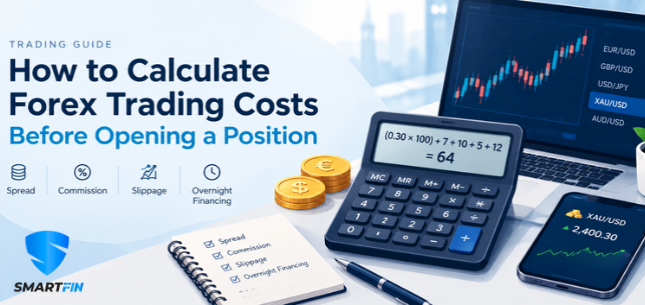
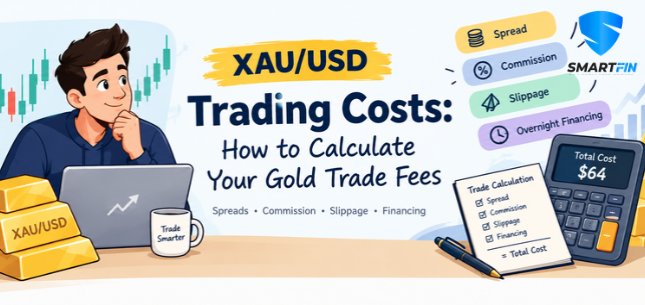
| Estimated total | $64 |
Under these assumptions, the estimated combined cost is $64.
This is not a live quote or an estimate of SmartFIN's actual charges. The calculation assumes that the listed amounts are measured consistently and that no other costs apply.
The example illustrates why a trader should consider the full transaction rather than comparing brokers using only one spread figure.
7. How to Compare Gold Trading Conditions
When comparing providers, use the same instrument, approximate position size, holding period, and market conditions.
Review the following:
- Contract specifications: Confirm the contract size, minimum volume, and price increment.
- Spread conditions: Understand whether the spread is variable and how it may change.
- Commission: Check the amount and whether it applies per side or round turn.
- Execution: Review the provider's execution policy and available order-history records.
- Financing: Check the applicable long and short overnight rates.
- Account currency: Determine whether conversion charges may apply.
- Additional fees: Review any relevant payment, account-maintenance, or withdrawal conditions.
A fair comparison should use the actual terms available to the client. A minimum advertised spread may not represent the spread available during the periods in which the client trades.
8. Why Position Size Matters
A wider spread increases the cost of a trade, but position size also affects the monetary impact.
For the same instrument and spread, doubling the position size generally doubles the spread cost. Commission and some financing charges may also increase with position size.
This is why margin requirements should not be confused with trading costs. Margin is the amount required to support a leveraged position; it is not the full cost of entering the trade or the maximum possible loss.
Before opening a position, traders should understand both the estimated transaction costs and the potential financial loss if the gold price moves against them.
Frequently Asked Questions
- Is XAU/USD trading cost determined only by the spread?
No. Depending on the account, costs can include commission, slippage, overnight financing, and currency conversion.
- How do I calculate the spread cost for gold?
A simplified calculation is the spread per ounce multiplied by the applicable contract size and position volume. Always confirm the instrument's actual contract specifications.
- Can the XAU/USD spread change during the day?
Yes. Variable spreads can change with liquidity, market volatility, rollover, and economic announcements. The extent of any change depends on the instrument and account conditions.
- Does holding gold overnight cost money?
An overnight financing adjustment may apply. Check the applicable long and short rates, rollover schedule and account terms before holding a position overnight.
- Is a lower gold spread always better?
Not necessarily. A useful comparison includes the complete cost of opening, holding, and closing a position, alongside execution conditions and the risks involved.
Final Considerations
Calculating the total cost of an XAU/USD trade requires more than looking at the spread. Commission, execution differences, financing and currency conversion may all affect the final result.
Use the instrument specifications and account terms that apply to your own account. Treat calculations as estimates, review actual trade statements, and remember that lower transaction costs do not guarantee a profitable trade.
Forex and CFDs are leveraged products that carry a high risk of financial loss. This article is for educational purposes only and is not financial or investment advice.