
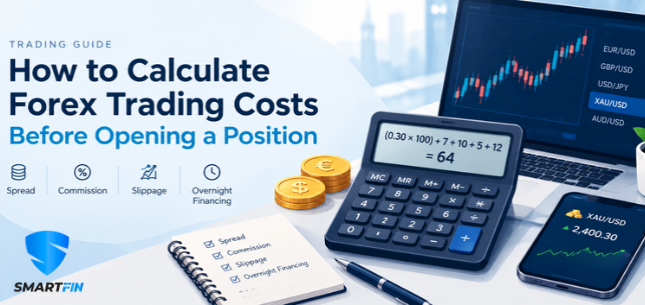
These costs can vary according to the instrument, account type, position size, market conditions, and broker's terms. A trade that appears inexpensive based on its displayed spread may have additional charges that need to be considered.
Learning how to calculate forex trading costs makes it easier to compare account conditions, estimate expenses, and understand how transaction costs affect a trading result. For traders comparing a forex broker in Dubai or elsewhere in the UAE, this is an important part of evaluating the overall trading experience.
1. What Are Forex Trading Costs?
Forex trading costs are the expenses associated with executing and maintaining a position. The exact charges depend on the account and instrument.
The main components are:
Spread: The difference between the bid and ask prices. A position generally incurs a spread cost when it is opened and subsequently closed through the opposite side of the quote.
Commission: A separate fee that may be charged per lot, per side or for a complete transaction.
Slippage: The difference between the expected execution price and the actual execution price. It can be favourable or adverse.
Overnight financing: A charge or adjustment that may apply when a position is held beyond the provider's rollover time.
Currency conversion: A conversion charge or exchange-rate difference may apply when the trading result or account transaction involves different currencies.
Not every account charges each component separately. Always check the applicable account agreement, instrument specifications, and fee schedule.
2. How to Calculate Spread Cost
The spread is often the first cost traders examine.
For a simplified example, assume a forex pair has the following quote:
- Bid price: 1.1000
- Ask price: 1.1002
- Spread: 0.0002, equivalent to 2 pips for a standard four-decimal-quoted major pair
For a standard lot of 100,000 units, the approximate spread cost in the quote currency is:
Spread cost = Spread in price units × Position size in base-currency units
Using the example:
0.0002 × 100,000 = 20 units of the quote currency.
If the instrument is EUR/USD, the approximate spread cost would be USD 20 for this assumed position and quote.
This is a simplified illustration. The exact monetary value depends on the instrument, contract specifications, position size and applicable quote conventions.
A wider spread generally increases the cost of entering and exiting a position, all else being equal. However, the displayed spread at a particular moment does not guarantee the execution cost throughout the trade.
3. How to Calculate Commission
Some accounts charge a separate commission for opening and closing a position.
Suppose an account has a hypothetical commission of USD 3.50 per lot per side.
For a one-lot trade:
- Opening commission: USD 3.50
- Closing commission: USD 3.50
- Total round-turn commission: USD 7.00
If the position size is 0.10 lot and the commission scales proportionally, the round-turn commission would be USD 0.70.
These amounts are illustrative and are not SmartFIN's published fees.
Before calculating commission, confirm whether the advertised rate applies per side, per lot, per transaction or to the complete round turn. Also check whether minimum charges or other conditions apply.
4. Include Slippage in the Cost Estimate
Slippage occurs when the execution price differs from the price expected when the order is submitted.
For example, suppose a buy order is submitted at an expected price of 1.1002 but is executed at 1.1003.
The difference is 0.0001, equivalent to one pip for this illustrative quote convention.
For a standard lot of EUR/USD, the approximate adverse price difference would be USD 10, assuming the position and quote conventions used in this example.
Slippage can occur on entry and exit. It may be favourable or adverse, and it can become more noticeable during periods of rapid price movement, changing liquidity or major economic announcements.
For a realistic assessment, traders should review their actual execution records rather than assume that every order will be filled at the displayed price.
5. Account for Overnight Financing
Holding a position overnight may result in a financing charge or adjustment.
The amount can depend on the instrument, position direction, position size, applicable rates, rollover schedule and account terms.
Suppose a hypothetical position incurs USD 4 in financing charges over its holding period.
That amount should be added to the estimated transaction costs. The actual charge should be checked against the applicable instrument specifications or account statement.
For positions held across multiple nights, financing can become a more important part of the total cost. Traders should therefore review the relevant rates before deciding how long to maintain a position.
6. Use a Simple Forex Trading Cost Calculation
A simplified estimate can be expressed as:
Estimated total cost = Spread cost + Commission + Adverse slippage + Financing charges + Other applicable costs
Consider this illustrative example for one completed position:
| Spread cost | USD 20.00 |
| Round-turn commission | USD 7.00 |
| Adverse entry slippage | USD 10.00 |
| Adverse exit slippage | USD 5.00 |
| Overnight financing | USD 4.00 |
| Estimated total cost | USD 46.00 |
Under these assumptions, the estimated cost is USD 46.
The figures are hypothetical and are intended to demonstrate the calculation method. They do not represent live spreads, fees or financing rates offered by SmartFIN or any other provider.
The estimate also assumes that each component is expressed in the same currency and that the spread, commission, slippage and financing amounts have been calculated consistently.
If the account uses a different base currency, any required conversion should be handled separately.
7. How Position Size Changes Trading Costs
Position size affects the monetary impact of many trading costs.
For example, if a spread cost is USD 20 for a particular position, a position twice as large would generally have approximately twice the spread cost under the same spread and contract assumptions.
Commission may also increase with volume, and financing charges commonly depend on the position size and applicable terms.
However, increasing position size also increases market exposure and can increase the potential loss from an adverse price movement.
Traders should distinguish between the estimated cost of executing a position and the potential market loss. Transaction costs are only one part of the overall risk.
8. Trading Costs Are Different From Margin
Margin is the amount of funds required to support a leveraged position under the applicable margin rules. It is not the same as the cost of executing the trade.
A trader may have sufficient margin to open a position while still facing spreads, commissions, financing charges and market risk.
For example, the margin required for a position may be USD 500, while the estimated transaction costs may be USD 46 under the illustrative assumptions above. The margin is not an additional USD 500 trading fee; it is the amount required to support the position.
Actual margin requirements depend on the instrument, contract size, leverage, account terms and market conditions.
Before placing an order, review both the margin requirement and the expected transaction costs.
9. How to Compare Forex Brokers Using Total Trading Costs
When comparing forex brokers in Dubai or across the UAE, evaluate more than a single advertised spread.
Consider the following:
- Spread conditions: Review whether spreads are fixed or variable and how they may change.
- Commission structure: Check the rate, calculation basis and whether it applies on entry and exit.
- Execution policy: Understand how orders are handled and how execution quality can be evaluated.
- Financing charges: Compare the applicable overnight rates and rollover conditions.
- Account currency: Check whether conversion fees or exchange-rate differences may apply.
- Instrument specifications: Confirm contract size, minimum volume and margin requirements.
- Additional charges: Review any applicable deposit, withdrawal or account-related fees.
For a more detailed explanation, read our guide to the real cost of forex trading in Dubai.
You can also learn how execution affects trading outcomes in How to Compare Forex Broker Execution.
For gold traders, our guide to calculating the total cost of an XAU/USD trade provides an instrument-specific example. Check that the destination URL is published and correct before using the link.
10. What to Check Before Opening a Position
Before submitting an order, take a moment to review:
- The current bid and ask prices
- The position size and applicable contract specifications
- The estimated spread cost
- Any opening and closing commissions
- Potential execution differences and slippage
- Overnight financing if the position may remain open
- Margin requirements and available free margin
- Any relevant conversion or payment charges
These checks do not eliminate trading risk, but they can help you understand the cost structure and avoid relying on incomplete fee comparisons.
Frequently Asked Questions
- How do I calculate forex trading costs?
Add the estimated spread cost, applicable commissions, adverse execution differences, financing charges and any other relevant costs. Convert each amount into a common currency before adding them together.
- Is the spread the only cost of forex trading?
No. Depending on the account, costs may also include commissions, slippage, overnight financing and currency conversion.
- Does a larger lot size increase trading costs?
Generally, many transaction costs increase with position size. The precise amount depends on the instrument, fee structure and account conditions.
- Does margin count as a trading fee?
No. Margin is the amount required to support a leveraged position. It should not be added to transaction costs as though it were a fee, although the position can incur losses and other charges.
- Can I calculate trading costs before opening a position?
You can estimate many costs using the current quote, position size, fee schedule and financing information. Actual execution prices, variable spreads and other market-dependent factors can cause the final cost to differ from the estimate.
- Why should UAE traders consider currency conversion?
If the account currency differs from the currency used to calculate a trading result or charge, conversion rates and applicable fees may affect the final amount credited or withdrawn.
Calculating forex trading costs before opening a position provides a clearer picture of the expenses associated with trading. Spreads, commissions, execution differences, overnight financing and currency conversion can all affect the final result.
Use the actual account terms and instrument specifications when estimating costs. Compare providers using consistent assumptions, and remember that lower transaction costs do not guarantee a profitable outcome.
Forex and CFDs are leveraged products that carry a high risk of financial loss. This article is for educational purposes only and is not financial or investment advice.