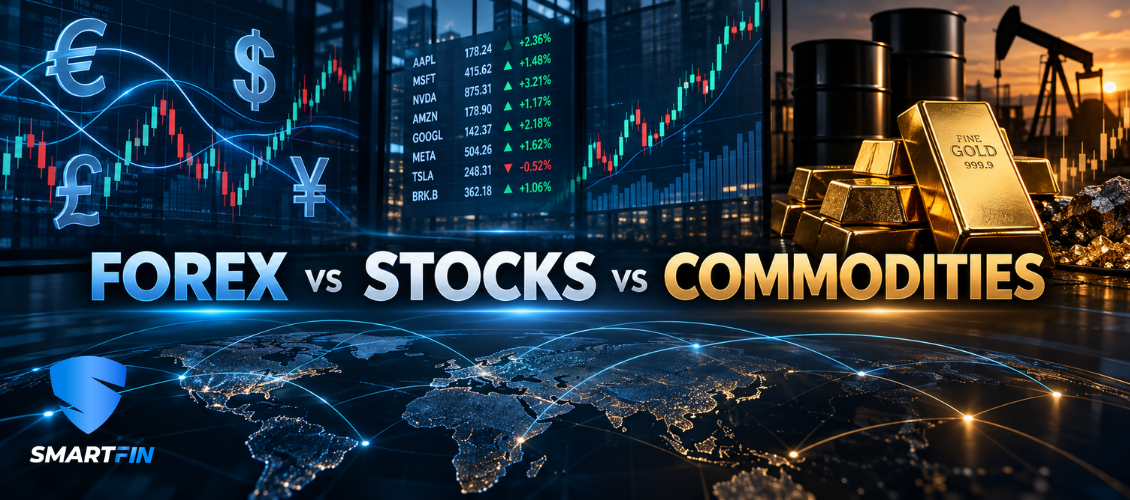
Forex involves the relative value of two currencies, stocks represent ownership in companies, and commodities are linked to resources such as gold, oil, and agricultural products.
They may appear together on the same trading platform, but they should not be analyzed as though they are the same market.
The principal differences
| Underlying market | Currency pairs | Company shares | Physical resources or related contracts |
| Main price drivers | Interest rates, inflation and economic expectations | Earnings, management and industry performance | Supply, demand, production and geopolitics |
| Typical hours | Nearly 24 hours, Monday to Friday | Exchange-specific hours | Contract and exchange-specific hours |
| Pricing | One currency relative to another | Price per company share | Price per unit or contract |
| Common risks | Leverage, volatility and macroeconomic events | Company and sector risk | Supply shocks and sharp price volatility |
Forex
Forex prices express the value of one currency against another. EUR/USD, for example, compares the euro with the US dollar.
Currency pairs can be affected by:
- Central-bank policy
- Interest-rate expectations
- Inflation
- Employment and growth
- International trade
- Political and geopolitical developments
- Global investor sentiment
Forex is primarily an over-the-counter market rather than one centralized international exchange. More information about its structure is available in Forex Trading Explained: How the Global Currency Market Works.
Stocks
Buying a physical share generally represents partial ownership in a company. Its value may be influenced by revenue, profitability, debt, management decisions, new products, competition and industry conditions.
A strong national economy does not guarantee that every company’s share price will rise. A company can underperform because of internal problems even when its broader market performs well.
Traders should also distinguish between owning physical shares and trading a derivative based on a stock’s price. Ownership rights, costs and risks may be different.
Commodities
Commodities include markets such as gold, crude oil, natural gas, silver and agricultural products.
Their prices may respond to:
- Production levels
- Physical supply and demand
- Inventories
- Weather
- Transportation disruptions
- Geopolitical conflict
- Industrial demand
- Currency movements
Oil can react sharply to supply disruptions or changes in production policy. Gold may respond to real interest rates, the US dollar, inflation expectations, and demand for defensive assets.
The markets are different—but connected
Forex, stocks and commodities frequently influence one another.
A stronger US dollar can place pressure on some dollar-priced commodities, although this relationship is not guaranteed. Rising oil prices may affect currencies associated with major oil-exporting or importing economies. Changes in interest-rate expectations can influence currencies, gold and equity valuations simultaneously.
These relationships can also change. A correlation that appeared reliable during one period may weaken or reverse when market priorities shift.
This is why opening positions across three markets does not automatically create diversification. A trader could buy gold, sell the US dollar, and purchase a rate-sensitive stock index—only to discover that all three positions depend on the same interest-rate expectation.
Which market is better?
There is no market that is objectively best for every participant.
Forex may suit someone interested in macroeconomics and relative currency values. Stocks may appeal to someone who prefers researching companies and industries. Commodities may suit those following physical supply, geopolitical developments, and global demand.
Before selecting a market, compare:
- Product structure
- Trading hours
- Total costs
- Volatility
- Liquidity
- Available leverage
- Overnight charges
- Information requirements
- Maximum acceptable loss
The better market is not necessarily the one moving fastest. It is the one the participant understands, can monitor and can approach with clearly defined risk.
Risk warning: Forex, CFDs, stocks and commodity-linked products involve different risks. Leveraged products can magnify losses. Verify whether a product provides ownership or only exposure to price movements before trading.