Anyone considering leveraged trading should understand the exposure, costs, and potential drawdown before deciding how much capital, if any, to place at risk.
Global markets make opportunity visible. Currency movements appear on screens throughout the trading week, and financial news explains the forces behind them. What remains less visible is the difference between an interesting market and an appropriate use of personal capital.
A persuasive forecast does not answer whether a position is affordable. That decision depends on what the money is needed for, the size of the exposure, and the consequences of being wrong.
Separate a trading balance from a financial plan
Money needed for rent, essential expenses, or near-term commitments serves a different purpose from money placed at speculative risk. Combining those purposes can create pressure to trade for a required income, even when market conditions do not support the decision.
The Investor.gov saving and investing roadmap starts with financial goals, understanding personal finances, high-interest debt, rainy-day savings, and risk tolerance. These considerations help frame the decision to participate in markets; they do not disappear when a trading platform becomes available.
Trading also differs from owning an investment for the long term. A forex or commodity CFD provides contractual exposure to price changes; it should not be confused with owning the underlying asset. SmartFIN's guide to forex, stocks and commodities is a useful starting point for understanding those differences.
Measure exposure rather than the margin deposit
Leverage allows a position's market exposure to exceed the capital committed as margin. It changes the effect of price movement on the account; it does not make the forecast more accurate. The SEC's forex investor bulletin explains how leverage can magnify losses and, depending on the agreement, create liability beyond the initial deposit.
Consider a simplified hypothetical account with $2,000 of equity and a position worth $40,000. Effective leverage is 20 times the account equity. A 1% adverse movement in that exposure would represent roughly $400, or 20% of the starting equity, before costs and any currency-conversion effects.
This is an illustration of exposure, not a recommended account size or leverage level. Actual profit and loss depend on the instrument, contract specifications, account currency, and execution. Margin requirements and automatic close-out rules can also affect how a position is maintained.
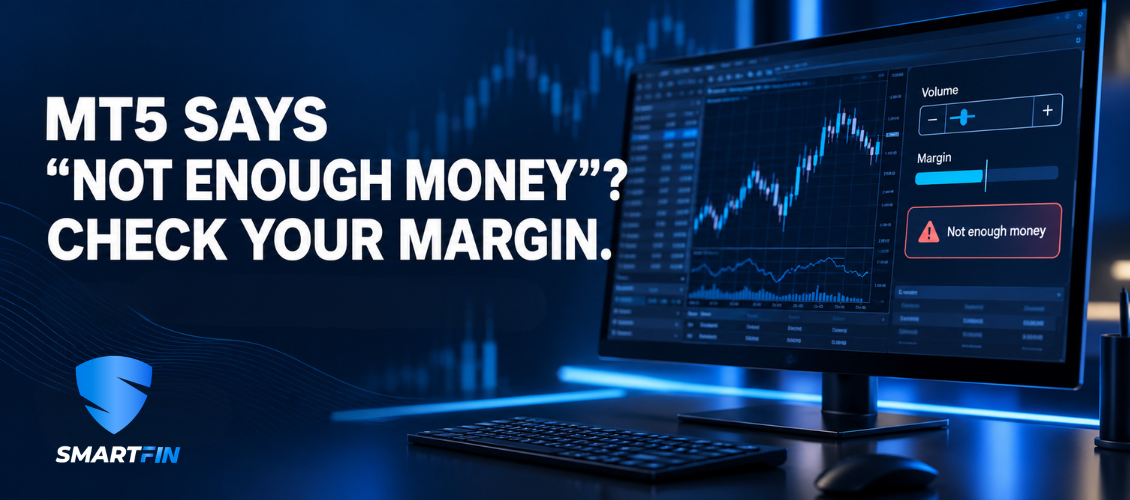
An order being accepted therefore says little about whether its risk is affordable. SmartFIN's article on the MT5 “Not Enough Money” message explains the funding and margin checks involved in placing an order.
Drawdowns make recovery harder
Percentage gains and losses do not cancel out symmetrically. If a hypothetical $10,000 account loses 20%, it falls to $8,000. Returning to $10,000 requires a 25% gain on the remaining balance. A 50% loss requires a 100% gain to recover, assuming no deposits or withdrawals.
This arithmetic helps explain why judging a trading approach only by its best month is incomplete. Review the size and duration of losses alongside returns. Include spreads, commissions, and any applicable overnight financing when assessing results.
For a more useful record, separate account changes into trading results, deposits, withdrawals, and costs. Depositing another $1,000 raises the balance, but does not demonstrate trading performance. Likewise, a profitable month says little about consistency without a longer record of exposure and losses.
Follow the relationship between open positions too. Several trades can express a similar view of the dollar even when their instrument names differ. Multiple positions should not automatically be treated as diversified risk.
Can forex trading provide steady monthly financial growth? Returns are uncertain and losses can occur. Neither a fixed monthly target nor access to leverage creates a reliable income stream. Evaluate the full financial situation and the possibility of losing the money committed.
Before considering an account, read the SmartFIN risk disclosure and the terms relevant to the entity serving you. A useful financial decision begins with understanding the downside as clearly as the potential upside.
This article provides general education, not personalized financial advice or a return promise. Leveraged forex and CFDs carry a high risk of loss and may be unsuitable for some people.