
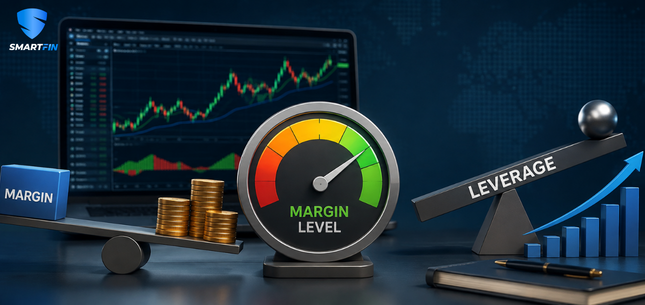
On MetaTrader 5, traders may see balance, equity, margin, free margin and margin level displayed together. Understanding how these figures interact can make it easier to evaluate the condition of an account while positions are open.
What Does Margin Level Mean?
Margin level compares equity with used margin.
The commonly used formula is:
Margin Level = (Equity ÷ Used Margin) × 100
For example, suppose:
Equity = $5,000
Used Margin = $1,000
The margin level would be:
($5,000 ÷ $1,000) × 100 = 500%
This means the account has five times as much equity as the amount currently being used as margin.
Why Does Margin Level Change?
Margin level can change continuously while positions remain open because equity changes with floating profit and loss.
Suppose an account begins with:
Balance = $5,000
Equity = $5,000
Used Margin = $1,000
Margin Level = 500%
If the open positions develop a floating loss of $2,000:
Equity becomes $3,000.
If used margin remains $1,000:
Margin Level becomes:
300%
The balance may still display $5,000 because the position has not yet closed, but the account's equity and margin level have changed.
What Causes Margin Level to Fall?
Margin level can fall when equity decreases relative to used margin.
Common reasons include:
- Increasing floating losses
- Opening additional leveraged positions
- Increasing total position size
- Changes in applicable margin requirements
- Significant market movements
This is why margin level should be considered before opening additional positions rather than only after an account comes under pressure.
Is a High Margin Level Good?
A relatively high margin level generally indicates that account equity is large relative to the margin being used.
However, there is no universal percentage that guarantees an account is safe.
Market conditions can change rapidly, particularly when leverage is being used.
A trader should therefore consider margin level alongside position size, volatility, stop-loss placement and total account exposure.
What Does 100% Margin Level Mean?
A margin level of 100% means:
Equity = Used Margin
For example:
Equity = $1,000
Used Margin = $1,000
Margin Level = 100%
At this point, free margin may be very limited.
Whether this results in restrictions on opening new positions, a margin call or eventual stop-out depends on the specific account conditions.
Margin Level vs Free Margin
Margin level is a percentage.
Free margin is a monetary amount.
For example:
Equity = $4,000
Used Margin = $1,000
Free Margin = $3,000
Margin Level = 400%
Both figures provide useful information, but they answer different questions.
Free margin shows remaining available equity after used margin.
Margin level shows the relationship between total equity and used margin.
What Happens If Margin Level Keeps Falling?
If open positions continue producing losses, equity can continue falling.
That can reduce both free margin and margin level.
If the account reaches specific margin-call or stop-out thresholds, certain account actions may occur according to the provider's trading conditions.
These thresholds are not universal.
Traders should check the exact margin-call and stop-out conditions applicable to their account rather than relying on a percentage seen in a generic online example.
Margin level is an important account-health indicator for leveraged trading.
It is calculated using the relationship between equity and used margin, which means it can change whenever floating profit or loss changes.
Rather than looking at margin level in isolation, traders should monitor it alongside balance, equity, free margin, position size and overall market exposure.
For a complete explanation, read Smartfin's Forex Margin & Leverage Explained: Complete Guide for UAE Traders.