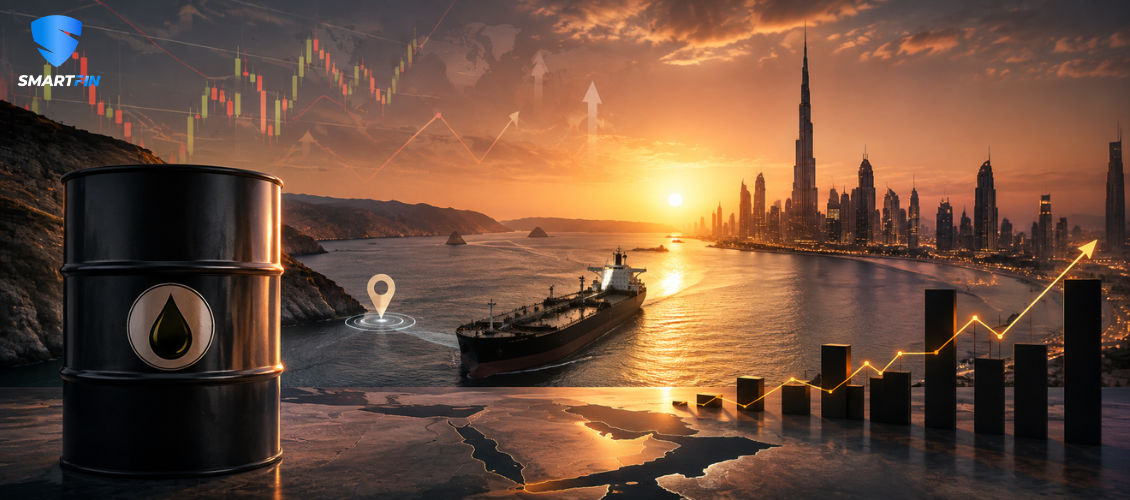
For Dubai, it is a trade, logistics, financial and investment story as well.
That distinction is becoming increasingly important as oil prices remain elevated and markets continue to assess the possibility of prolonged disruption to shipping through the Gulf.
Oil prices steadied in Thursday trading as investors weighed the outlook for the US-Iran conflict and the potential consequences for supply.
But crude prices themselves are only the visible part of the equation.
The more consequential question is what happens if elevated energy prices begin feeding into the rest of the economy.
Why the cause of the oil rally matters
There are two broad reasons oil can rise.
The first is stronger demand.
The second is restricted supply.
They have very different implications.
A demand-driven oil rally can indicate stronger global economic activity.
A supply-driven rally caused by geopolitical disruption can instead create a difficult combination of higher energy costs and weaker confidence.
That is the environment investors are trying to assess now.
The latest tensions surrounding Iran and the Strait of Hormuz have increased concern over the reliability of energy and shipping flows. Reuters has reported that the waterway remains a major point of contention, with conflicting claims over its operational status and continuing uncertainty surrounding maritime traffic.
For markets, uncertainty itself has a price.
Dubai's exposure is broader than oil
Dubai is not primarily an oil-production market.
That is precisely why the consequences of a prolonged shipping disruption deserve careful attention.
Dubai's economic model is built around international connectivity.
Trade.
Logistics.
Aviation.
Tourism.
Financial services.
Real estate.
These sectors are interconnected.
A sustained increase in shipping costs can eventually affect logistics companies and importers.
Higher energy prices can raise transportation expenses.
A prolonged geopolitical shock can influence tourism and business confidence.
Financial markets may then respond by demanding a higher risk premium.
None of these effects needs to happen immediately.
But investors will increasingly look for evidence that the geopolitical situation is moving from a financial-market event into an economic event.
Oil can support the Gulf and pressure the global economy at the same time
This is one of the most misunderstood aspects of the current market.
Higher crude prices can support revenues across oil-producing economies.
At the same time, higher energy costs can increase inflation in oil-importing countries.
That can create an unusual global split.
The Gulf may benefit from stronger energy revenues while major trading partners face higher input costs.
For central banks, the situation is particularly difficult.
If energy-driven inflation remains elevated, policymakers may be reluctant to ease monetary policy aggressively.
That keeps interest rates and bond yields relevant.
And once bond yields enter the equation, the story returns to currencies and gold.
The forex connection
The UAE dirham itself is not the obvious trading instrument here because the Central Bank of the UAE maintains the dirham's fixed relationship with the US dollar, with intervention rates of 3.672 for buying US dollars and 3.673 for selling.
But the UAE's position within the dollar system means that global currency moves remain highly relevant.
Traders should therefore look beyond USD/AED and monitor the major floating currencies.
USD/CAD
Canada's large energy sector means oil can become an important variable in the pair.
USD/JPY
Changes in global risk sentiment and US-Japanese yield differentials can influence the yen.
EUR/USD
A sustained energy shock can alter inflation expectations and therefore the relative monetary-policy outlook between Europe and the United States.
Gold
Gold remains particularly sensitive to the combination of geopolitical risk, Treasury yields and the US dollar.
The Dubai equity market is the next transmission point
The recent decline in UAE equities provides an important real-time indicator.
On August 19, Dubai's index fell 0.3%, while Abu Dhabi declined 0.9%. Reuters reported notable declines in Emirates NBD and First Abu Dhabi Bank, illustrating the sensitivity of financial shares to the latest risk repricing.
The question now is whether the reaction remains contained.
A contained reaction would suggest that investors see the current oil and geopolitical situation as manageable.
A wider sell-off across banks, property, transport and consumer names would tell a different story.
That would indicate that investors are beginning to price a broader economic impact.
What would change the market narrative?
There are several potential catalysts.
A de-escalation
A credible reduction in geopolitical tension could rapidly lower the risk premium embedded in oil and regional equities.
A prolonged Hormuz disruption
This would likely keep energy markets volatile and could increase pressure on global inflation expectations.
A sustained oil-price surge
The longer energy prices remain elevated, the greater the probability that the impact spreads beyond the energy sector.
A deterioration in global risk appetite
If geopolitical uncertainty combines with tighter global financial conditions, Gulf equities could face a more difficult environment.
Dubai's resilience will be tested through transmission channels
The UAE's diversification is an important buffer.
But diversification does not mean isolation.
Dubai remains deeply connected to global capital, international trade and regional logistics.
That is why the current market should be watched through transmission channels rather than headlines.
The important questions are:
Is shipping being disrupted?
Are energy costs remaining elevated?
Are financing conditions changing?
Are companies adjusting their expectations?
Is investor risk appetite deteriorating?
Those answers will ultimately matter more than any single day's oil price.
The Strait of Hormuz has become one of the most important variables for global markets this week.
For Dubai, however, the real issue is not simply the price of crude.
It is whether a geopolitical energy shock begins to alter the economics of trade, logistics, financing and investment.
That is why oil traders are watching the Strait.
Why forex traders are watching oil.
Why bond traders are watching inflation.
And why Dubai investors are watching all of them.
This article is for educational and informational purposes only and does not constitute investment advice. Market prices can move rapidly, and losses can exceed expectations, particularly when trading leveraged products.