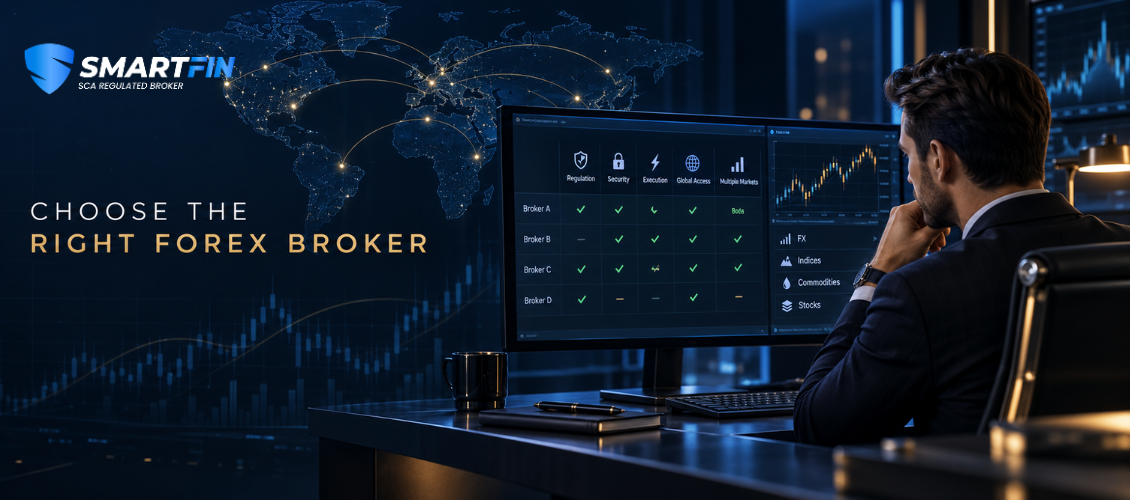
Choosing a forex broker is not simply a matter of comparing spreads or downloading the trading platform with the most features.
A broker becomes part of the infrastructure through which you access the financial markets. Its regulatory status, trading conditions, execution arrangements, platform, account procedures and risk controls can all affect your trading experience.
This makes broker selection an important due-diligence exercise, particularly for traders looking for a forex broker in the UAE.
Instead of asking:
“Which forex broker is the best?”
A more useful question is:
“Does this broker provide the regulatory framework, trading conditions, platform, instruments and account procedures that match my requirements?”
This guide provides a practical checklist UAE traders can use before opening and funding a forex trading account.
1. Verify the Broker's Regulatory Status
Regulation should be one of the first areas you investigate when researching a forex broker in the UAE.
Do not rely solely on statements such as "regulated," "licensed," or "authorized" displayed on a website.
Identify the exact legal entity you will be dealing with and verify the relevant licence or authorization with the regulator where applicable.
Depending on where and how a financial services company operates in the UAE, different regulatory frameworks can apply.
What should you verify?
Before opening an account, check:
- The broker's full legal entity name
- The regulator responsible for that entity
- Licence or registration details
- The financial activities the entity is authorized to conduct
- Whether the website and contact information correspond with the regulated entity
- Any applicable restrictions or conditions
This distinction is important because a brand name and the legal entity operating the trading account may not always be identical.
How can I check whether a forex broker is regulated in the UAE?
Start by identifying the legal entity and regulator disclosed by the broker. Then independently verify the information using the relevant regulator's official register rather than relying exclusively on information displayed on the broker's website.
2. Identify the Legal Entity Behind Your Trading Account
A professional-looking website does not tell you which company is legally responsible for your account.
Before depositing money, locate information such as:
- Company name
- Registered address
- Licence details
- Terms and conditions
- Client agreement
- Risk disclosure
- Privacy policy
Then determine which legal entity will actually hold or service your trading account.
This is especially important when a financial group operates multiple entities in different jurisdictions.
Your account relationship, applicable rules, and certain protections may depend on the specific entity under which your account is opened.
3. Understand the Real Cost of Trading
Many traders begin their broker comparison by looking at one number:
the spread.
Spreads matter, but they do not necessarily represent the complete cost of trading.
Depending on the account and instrument, trading costs can potentially include:
- Bid-ask spread
- Trading commissions
- Overnight financing or swap charges
- Currency conversion costs
- Deposit or withdrawal charges where applicable
- Other account-related fees
Should I choose the forex broker with the lowest spread?
Not necessarily.
A low advertised spread should be considered alongside commissions, execution conditions, overnight charges and other applicable costs.
For example, a trader holding positions overnight may care significantly about swap or financing costs, while a short-term trader may pay more attention to spreads, commissions and execution.
The important comparison is therefore not:
Who advertises the lowest spread?
It is:
What is the total cost of executing my trading strategy?
This distinction can make the article considerably more useful than standard "best broker" comparisons.
4. Test the Trading Platform Before Depositing
Your forex trading platform is the interface through which you analyze markets, place orders and manage positions.
Therefore, platform quality should be evaluated practically rather than from screenshots.
Where a demo environment is available, test it before funding an account.
Look at:
- Order placement
- Chart functionality
- Available timeframes
- Pending orders
- Stop-loss and take-profit functionality
- Instrument specifications
- Market Watch
- Trading history
- Mobile usability
- Desktop stability
Is MT5 important when choosing a forex broker?
MetaTrader 5 (MT5) is a widely used multi-asset trading platform offering charting, order-management and analytical functionality.
However, the presence of MT5 alone should not determine your choice of broker.
Think of the distinction this way:
Broker = the financial services provider through which the account and market access are provided.
Trading platform = the software used to view markets and submit/manage trading orders.
A good platform does not replace the need to evaluate the broker itself.
5. Understand How Orders Are Executed
This is an area many beginner-focused broker articles overlook.
Traders should understand what can happen after they click Buy or Sell.
Review the broker's available documentation regarding:
- Order execution
- Market orders
- Pending orders
- Stop orders
- Slippage
- Gaps
- Requotes, where applicable
- Market liquidity
- Volatile trading conditions
Why can execution price differ from the price you see?
Markets can move between the time an order is triggered and the time it is executed. Liquidity, volatility, price gaps and the characteristics of the order can affect execution.
This becomes particularly important around major economic announcements.
News-event execution
During high-impact events such as central-bank decisions, inflation releases or employment reports, market conditions can change extremely quickly.
Traders may experience:
- Wider spreads
- Reduced liquidity
- Rapid price movements
- Slippage
- Price gaps
A stop-loss is an important risk-management instruction, but traders should understand how stop orders operate under fast-moving market conditions.
Recommended internal link:
→ Why Did My Stop Loss Execute at a Different Price? Understanding Slippage and Market Gaps
This gives Smartfin an excellent opportunity to create a separate educational article around a high-intent long-tail search query.
6. Check Available Markets and Instruments
A broker offering hundreds or thousands of instruments is not automatically better than one offering fewer.
What matters is whether the instruments available match your actual trading requirements.
A multi-asset trading environment may provide access to markets such as:
Forex
Currency pairs can include majors, minors and other available pairs.
Traders should examine not only whether a currency pair exists but also its contract specifications, trading hours, margin requirements and applicable costs.
Gold / XAUUSD
Gold is closely followed by many online traders, including traders in the UAE.
If you intend to trade XAUUSD, review its:
- Contract size
- Minimum trade volume
- Spread
- Margin requirements
- Trading hours
- Swap/financing conditions
- Stop levels or other applicable specifications
Commodities
Depending on the forex broker checklist, traders may be able to access instruments related to energy and metals.
Each instrument can behave differently, so do not assume forex trading conditions automatically apply to commodities.
Indices
Index-based instruments provide exposure to movements in groups of listed companies rather than an individual company.
Again, contract specifications matter.
Stocks and other CFDs
Where offered, CFDs can provide exposure to price movements in underlying markets without necessarily providing ownership of the underlying asset.
Traders should understand the product before trading it.
The question that matters
Instead of asking:
"How many instruments does this broker offer?"
Ask:
"Does the broker provide the instruments that actually fit my trading requirements?"
A long instrument list has little value if the markets you trade have unsuitable costs, specifications or trading conditions.
7. Understand Leverage Before Using It
Forex leverage is often presented as a headline feature when brokers are compared.
That can encourage traders to assume that higher leverage automatically means better trading conditions.
It does not.
Leverage allows a trader to control market exposure that is larger than the margin required to establish that exposure.
For example, margin represents the amount required to support a leveraged position rather than necessarily representing the full economic exposure of that position.
This means traders researching forex margin in the UAE should understand the relationship between:
Account equity → Margin → Position size → Market exposure → Potential profit/loss
The critical point is that leverage affects both sides of the equation.
Does higher leverage mean a better forex broker?
No.
Higher leverage increases the amount of market exposure that can be controlled with a given amount of margin, which can amplify both gains and losses.
Therefore, leverage should be evaluated as a risk and exposure parameter, not as a promotional benefit.
Before trading, understand concepts including:
- Used margin
- Free margin
- Margin level
- Leverage
- Equity
- Stop-out conditions
This section can also internally link to Smartfin educational articles such as "What Is Margin Level in MT5?", "Free Margin vs Margin in Forex", and "What Happens When Margin Level Reaches 100%?"
8. Review Deposit and Withdrawal Procedures
Traders often research how to deposit money but spend much less time investigating the withdrawal process.
Both deserve attention.
Before funding an account, understand:
Supported payment methods
Determine which deposit and withdrawal methods are supported and whether there are restrictions depending on your location or account.
Processing procedures
Check how withdrawal requests are submitted and what processing steps apply.
Do not confuse a broker's internal processing time with the time required by banks, payment providers or other intermediaries.
Fees
Check whether charges may apply to:
- Deposits
- Withdrawals
- Currency conversion
- Payment providers
- Bank transfers
Verification requirements
Financial institutions may require identity or payment-method verification before certain transactions can be processed.
Understanding these requirements in advance can reduce confusion later.
Currency conversion
If your trading account, bank account and payment method use different currencies, conversion costs or exchange-rate differences may become relevant.
A simple pre-deposit question is:
"If I deposit using this method, what is the complete procedure for withdrawing my funds later?"
The answer can reveal considerably more than a "Deposit Now" page.
9. Test Customer Support Before You Need It
Most traders contact customer support for the first time after something has gone wrong.
Reverse that process.
Contact the broker before depositing.
Instead of asking a generic question such as "How do I open an account?", ask a moderately technical question.
For example:
"Where can I find the margin requirements and contract specifications for XAUUSD?"
Or:
"Can you explain your withdrawal verification procedure?"
Then evaluate the response.
Consider:
- Was the answer relevant?
- Was the information clear?
- Did the representative answer the actual question?
- Were you directed to official documentation where appropriate?
- Were complex questions handled professionally?
- Were risks explained rather than dismissed?
Good customer support is not simply about answering quickly.
Accuracy and clarity matter more than speed alone.
10. Check Account Security and KYC Procedures
Security should be considered part of broker due diligence rather than an inconvenience during registration.
A broker may require Know Your Customer (KYC) procedures to verify a client's identity and other relevant information.
Depending on the circumstances, this can involve:
- Identity verification
- Address or residency information
- Contact verification
- Source-related information where required
- Document verification
- Payment verification
You should also evaluate how the client account itself is managed.
Look for appropriate controls around:
- Client portal access
- Password management
- Account information
- Personal data
- Withdrawal requests
- Identity verification
- Privacy procedures
Be cautious if a provider appears more interested in receiving a deposit than completing appropriate account verification.
11. Read the Risk Disclosure
This may be one of the least exciting pages on a broker's website.
It can also be one of the most important.
Leveraged trading involves substantial risk, and traders should understand that losses are possible.
Read the broker's risk disclosure and client documentation before opening an account.
Pay particular attention to marketing language.
Statements implying concepts such as:
- Guaranteed profits
- Risk-free trading
- Certain returns
- Guaranteed daily income
- Easy money
should warrant serious caution.
Trading is inherently uncertain.
A credible financial services provider should explain risk rather than pretend it does not exist.
This principle is particularly important for beginners who may encounter unrealistic trading claims on social media.
12. Forex Broker Checklist for UAE Traders
Before choosing a forex broker in the UAE, run through this final due-diligence checklist:
☐ Regulatory status independently verified
☐ Legal entity identified
☐ Authorized activities checked
☐ Trading costs understood
☐ Trading platform tested
☐ Execution policy reviewed
☐ Leverage and margin understood
☐ Required instruments checked
☐ Contract specifications reviewed
☐ Deposit procedures understood
☐ Withdrawal procedures reviewed
☐ Customer support tested
☐ Risk disclosure read
☐ Account security reviewed
If several of these questions cannot be answered clearly, further research may be appropriate before funding an account.
Questions UAE Traders Frequently Ask About Choosing a Forex Broker
How do I choose a forex broker in the UAE?
Start with regulatory and legal-entity verification. Then compare the broker's total trading costs, execution arrangements, trading platform, available instruments, leverage and margin requirements, deposit and withdrawal procedures, customer support, security practices, and risk disclosures.
The objective should be to find a broker whose services match your requirements rather than simply selecting the provider advertising the lowest spread or highest leverage.
How can I check whether a forex broker is regulated in the UAE?
Identify the exact legal entity named in the broker's legal documentation and determine which regulator supervises that entity. Where an official register is available, independently verify the licence and authorized activities through the regulator rather than relying solely on claims displayed on the broker's website.
What should I look for in a forex trading platform?
Evaluate order functionality, charting tools, platform stability, instrument specifications, available order types, account history and usability across the devices you intend to use.
A demo account can be useful for familiarizing yourself with the platform before trading with real funds.
Is MT5 important when choosing a forex broker?
MT5 can provide useful charting, order-management and multi-asset trading functionality, but platform availability should be only one part of broker selection.
Regulation, execution, costs, instruments, account procedures and risk controls should also be evaluated.
Should I choose the forex broker with the lowest spread?
Not automatically.
Spreads represent only one possible component of trading costs. Commissions, overnight financing, execution conditions, conversion costs and other applicable charges should also be considered.
Compare the overall cost relevant to your trading style rather than one advertised number.
What fees should I check before opening a forex account?
Depending on the broker, account type and instruments involved, relevant costs may include spreads, commissions, overnight financing or swaps, currency conversion costs and applicable transaction or account charges.
Review the broker's official fee and trading-condition documentation before opening an account.
What is the difference between a forex broker and a trading platform?
A forex broker provides the account and access to the trading environment, subject to its applicable services and regulatory framework.
A trading platform is the software through which traders view prices, analyze markets and submit or manage orders.
MT5, for example, is a trading platform rather than a broker.
Is higher leverage better for forex trading?
No.
Higher leverage allows greater market exposure relative to the margin used, but this also increases the potential impact of market movements on the trading account.
Leverage should therefore be evaluated from a risk-management perspective rather than treated as an indication of broker quality.
What should beginners check before opening a forex account in Dubai?
Beginners should understand the broker's regulatory status, legal entity, account type, trading costs, leverage, margin requirements, platform, execution arrangements, deposit and withdrawal procedures and risk disclosures before depositing.
They should also understand fundamental trading concepts such as position sizing, stop losses, margin level and leveraged risk before moving from a demo environment to live trading.
Conclusion: Choose a Broker Based on Evidence, Not Advertising
The search for a forex broker in Dubai or the UAE should not begin and end with a comparison table showing spreads and leverage.
Broker due diligence requires looking deeper.
Verify the legal entity. Check the regulation. Understand the costs. Test the platform. Read the execution documentation. Examine the instruments you actually intend to trade. Understand leverage and margin. Investigate withdrawals. Test customer support. Review security procedures. And read the risk disclosure.
Most importantly, avoid treating any single feature as proof that one broker is "better."
The better question is:
Does this broker provide the regulatory framework, platform, trading conditions and services appropriate for the way I intend to trade?