
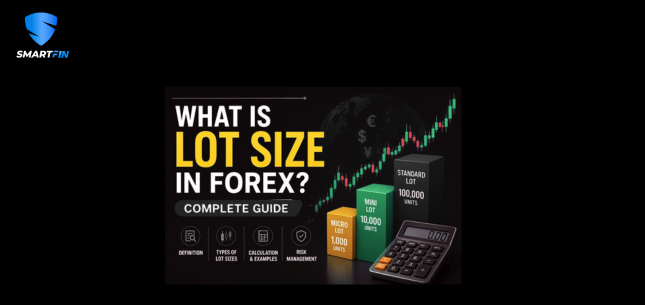
What Is a Lot in Forex?
A lot represents trading volume.
MetaTrader's instrument specifications define contract size as the number of units of the underlying currency, commodity, or financial asset represented by one lot.
For many retail forex pairs, common conventions are:
1.00 standard lot = 100,000 units
0.10 lot = 10,000 units
0.01 lot = 1,000 units
However, traders should always check the actual contract specification of the instrument being traded rather than assuming all products use identical values.
Position Size Should Start With Risk
Beginners often think:
I have $5,000, so what lot size can I trade?
A better question is:
How much am I prepared to risk if this trade is wrong?
Suppose:
Account = $10,000
Risk = 1%
Maximum planned loss = $100
Stop Loss = 50 pips
You then calculate a position size where approximately 50 pips corresponds to the planned $100 risk, taking into account the instrument's pip/tick value.
Conceptually:
Position Size = Money at Risk ÷ (Stop Distance × Value Per Pip at the chosen volume)
Why Stop-Loss Distance Changes Lot Size
Consider two trades.
Trade A:
Stop = 20 pips
Trade B:
Stop = 100 pips
If you want to risk the same amount of money on both trades, Trade B normally requires a smaller position.
This is why using the same lot size for every trade can create inconsistent risk.
Lot Size vs Leverage
Lot size controls market exposure.
Leverage affects how much margin may be required to support that exposure.
These are related concepts, but they are not identical.
Increasing leverage doesn't magically make a large trade a small-risk trade.
What About Gold?
Do not automatically apply forex lot calculations to XAU/USD.
Gold contract sizes and tick values should be checked through the specific instrument's contract specification.
The same applies to indices, commodities, and CFDs.
Final Conclusion
Professional position sizing begins with:
How much can I afford to lose if this setup fails?
—not:
What is the biggest position the platform allows me to open?
That small change in thinking is one of the most important steps in responsible forex trading.