
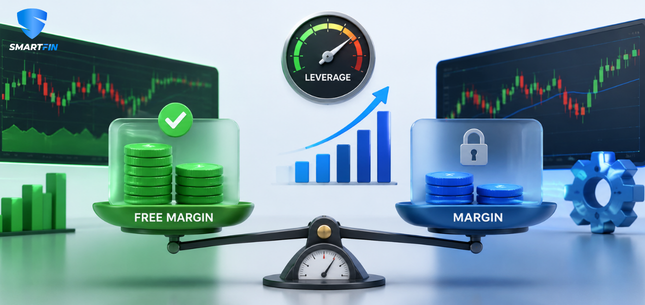
Margin is the amount allocated to support open leveraged positions, while free margin is the portion of equity that remains after used margin is taken into account.
Understanding the difference is particularly important when multiple trades are open because a trading account can have a positive balance but still have limited free margin available.
What Is Margin?
When a leveraged position is opened, a certain amount may be required to support that position.
This is margin.
The amount required can depend on the instrument, position size, contract specifications, market price and applicable leverage.
For example, imagine an account has $5,000 in equity and an open position requires $1,000 in margin.
That $1,000 becomes used margin while the position remains open, subject to the account's applicable conditions.
What Is Free Margin?
Free margin is the amount of equity that remains after used margin is taken into account.
A simplified formula is:
Free Margin = Equity − Used Margin
If:
Equity = $5,000
Used Margin = $1,000
then:
Free Margin = $4,000
Free margin acts as part of the account's remaining capacity.
Margin vs Free Margin
The easiest way to understand the difference is:
Margin = equity currently supporting positions
Free margin = equity not currently allocated as margin
Suppose:
Balance = $10,000
Equity = $9,000
Used Margin = $2,000
Free Margin = $7,000
The $2,000 is supporting existing positions.
The $7,000 represents the remaining free margin at that moment.
Why Does Free Margin Keep Changing?
Free margin can change continuously while positions are open.
One major reason is floating profit and loss.
If open positions move against the trader, floating losses reduce equity.
Because:
Free Margin = Equity − Used Margin
a reduction in equity can also reduce free margin.
Imagine:
Balance = $5,000
Used Margin = $1,000
Initially, floating P/L = $0.
Equity = $5,000
Free Margin = $4,000.
Now suppose the position develops a $1,500 floating loss.
Equity becomes:
$3,500
If used margin remains $1,000:
Free Margin becomes:
$2,500
No additional position was opened, yet free margin decreased because equity fell.
What Happens When You Open Another Trade?
Opening another leveraged position will normally require additional margin.
Suppose:
Equity = $5,000
Existing used margin = $1,000
Free margin = $4,000
A new trade requires another $500 in margin.
Used margin may then increase to approximately:
$1,500
If equity remains $5,000:
Free margin becomes approximately:
$3,500
This demonstrates why repeatedly opening new positions can reduce the amount of free margin available.
Can You Have Money in Your Account but Not Enough Free Margin?
Yes.
This is one reason traders sometimes receive an insufficient funds or not enough money message on MT5 even though their account balance is positive.
The trading system does not consider balance alone.
It also needs to determine whether sufficient free margin exists to support the requested position.
An account could therefore have a balance of $5,000 but very little available free margin because existing positions are using margin and floating losses have reduced equity.
Is More Free Margin Always Better?
Having a larger free-margin buffer generally gives an account more capacity to absorb market movement.
However, free margin should not be interpreted as money that must be used.
A trader with $8,000 of free margin does not need to open positions until that amount is exhausted.
Risk management should determine position size rather than maximum available margin.
Free Margin and Margin Level
Free margin should also be considered alongside margin level.
Margin level is commonly calculated as:
Margin Level = (Equity ÷ Used Margin) × 100
As equity decreases relative to used margin, margin level falls.
This means free margin and margin level can both deteriorate when open positions experience significant floating losses.
Why Traders Should Monitor Both
Margin tells you how much equity is currently supporting positions.
Free margin tells you how much equity remains outside that used margin.
Looking at only one figure can therefore be misleading.
A better account overview includes:
Balance + Equity + Used Margin + Free Margin + Margin Level
Together, these figures provide a more complete picture of the trading account.
The difference between margin and free margin is straightforward once their roles are separated.
Margin supports existing leveraged positions.
Free margin is the remaining equity after used margin has been accounted for.
As trades move, equity changes. As equity changes, free margin can change as well.
Understanding this relationship can help explain why new orders may be rejected, why margin level changes and why account balance alone does not show the complete condition of an active trading account.
To understand how margin, leverage, equity and margin level work together, continue with Smartfin's Forex Margin & Leverage Explained: Complete Guide for UAE Traders.